How Long to Boil Eggs Hard Boiled (The Direct Answer)
Hard boil eggs for exactly 12 minutes in already-boiling water, or 14 minutes starting from cold water, then transfer immediately to an ice bath. That's the short answer, and it's the number you can bookmark right now.
The longer answer depends on a few variables worth knowing. For a fully hard boiled egg with a firm, completely set yolk, the boiling-water-start method takes 12 minutes and the cold-water-start method takes 14 minutes, both measured for large eggs. RecipeTinEats covers this well and reinforces that large eggs are the universal benchmark for all standard timing guides. If you're working with medium eggs, knock off one minute. Extra-large eggs need an extra 1 to 2 minutes.
It's also helpful to understand how doneness levels shift the timeline. Soft boiled sits at 6 minutes (boiling start), medium boiled lands at 9 to 10 minutes, and hard boiled is 12 to 14 minutes depending on which method you use. We cover the full breakdown in our soft vs. hard boiled timing guide if you want to see the complete spectrum. We also have a separate guide to types of eggs that's worth checking if you're unsure whether egg size or type affects your cooking time, because it does.
One thing that surprises most home cooks: eggs aged 7 to 10 days in the refrigerator peel dramatically more easily than eggs bought the same morning. As an egg ages, the pH of the albumen (the white) rises, which weakens the bond between the white and the inner shell membrane. Grocery store eggs are typically already 1 to 2 weeks old, which is actually ideal for hard boiling.
Finally, the ice bath isn't optional. As Butter Be Ready explains, transferring eggs immediately to ice water is the single most important step to prevent the grey-green ring that forms around an overcooked yolk. More on that in the tips section below.
What You Need Before You Start Boiling Eggs
Getting the equipment ready before the eggs go anywhere near the stove makes the whole process smoother. Here's what you need on the counter before you start.
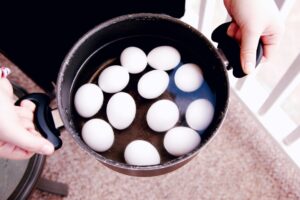
The pot. Use a medium or large saucepan that's deep enough to cover your eggs by at least one inch of water. A pot that's too shallow cooks unevenly because the tops of the eggs won't be fully submerged, leading to partly runny whites. If you're cooking more than six eggs, size up accordingly.
The eggs. For the cold-water-start method, eggs can go straight from the refrigerator into the pot. For the boiling-water-start method, letting eggs sit at room temperature for 5 to 10 minutes before they go into already-boiling water reduces the risk of shells cracking on impact. Either way, eggs that have been sitting in your refrigerator for 7 to 10 days will peel far more easily than farm-fresh eggs. Check out our egg float test guide if you want to confirm your eggs are still fresh before cooking.
The ice bath. Fill a large bowl with cold water and a generous amount of ice before the eggs even touch the stove. There's no time to hunt for ice cubes after the timer goes off. RecipeTinEats and Butter Be Ready both emphasise preparing the ice bath in advance as a non-negotiable step.
A slotted spoon or spider strainer. These tools let you move eggs quickly from boiling water to the ice bath without burning your hands or cracking shells on the side of the pot. A regular spoon works too, but a spider strainer is faster when you're moving several eggs at once.
An altitude note. If you live above 3,500 feet (1,067 m), your water boils below 212°F (100°C). That lower boiling point slows cooking, so you'll need to add 1 to 2 extra minutes to any sea-level timing you see in recipes. We detail this further in the method steps below.
Step-by-Step: How to Hard Boil Eggs Perfectly (Both Methods)
There are two reliable stovetop methods for hard boiling eggs. Both produce excellent results. The right choice depends on your comfort level and what you've got on hand.
Method 1: Boiling-Water Start (Preferred for Precision)
This is the method professional chefs reach for, including the approach we use at The Top Kitchen. It gives you the tightest control over timing.
- Fill a medium saucepan with enough water to cover your eggs by at least one inch. Bring it to a full, rolling boil over high heat.
- While the water heats, let your refrigerator-cold eggs sit on the counter for about 5 minutes to take the edge off the chill. This reduces cracking.
- Using a slotted spoon, lower each egg gently into the boiling water one at a time. Don't drop them.
- Reduce the heat to a gentle boil (you don't need a violent rolling boil, which knocks eggs together and can crack shells).
- Start your timer. For large eggs, cook for exactly 12 minutes for hard boiled with a fully set yolk. For medium eggs, 11 minutes. For extra-large, 13 to 14 minutes.
- Immediately transfer eggs to an ice bath and leave them for at least 5 minutes, ideally 10 to 15.
RecipeTinEats uses this method and notes that the rolling boil start gives you the most consistent, repeatable results once you've done it a couple of times.
Method 2: Cold-Water Start (Best for Beginners)
This method is more forgiving. Because the eggs warm up gradually with the water, there's no thermal shock and virtually no risk of cracking.
- Place your eggs in a single layer in a cold saucepan. Don't stack them.
- Cover with cold water by at least one inch.
- Bring to a boil over medium-high heat. Stay nearby, because this is the step where timing begins.
- The moment the water reaches a full boil, remove the pan from the heat and put the lid on.
- Let the eggs sit in the covered hot water for 14 minutes for large hard boiled eggs.
- Transfer immediately to the ice bath for 10 to 15 minutes.
The cold-water start uses residual heat to finish cooking the egg, which discussions on Reddit's r/cookingforbeginners confirm is a favourite approach for people who want a stress-free result. Butter Be Ready also recommends this route for home cooks who aren't yet confident managing boiling water temperatures.
Timing Table by Doneness Level
| Doneness | Boiling-Water Start | Cold-Water Start |
|---|---|---|
| Soft boiled | 6 minutes | 8 minutes |
| Medium boiled | 9–10 minutes | 11–12 minutes |
| Hard boiled | 12 minutes | 14 minutes |
All times are for large eggs. Want to see what the finished yolk should look like at each stage? Check out our guide to hard boiling eggs perfectly for step-by-step photos and descriptions. We also have a full overview of ways to cook an egg if you want to see how hard boiling compares to poaching, frying, and other techniques. For a completely different approach, our Instant Pot hard boiled eggs method is worth a read.
How to Tell if Your Egg Is Done (Without Cracking It)
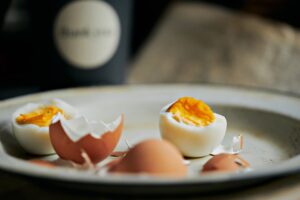
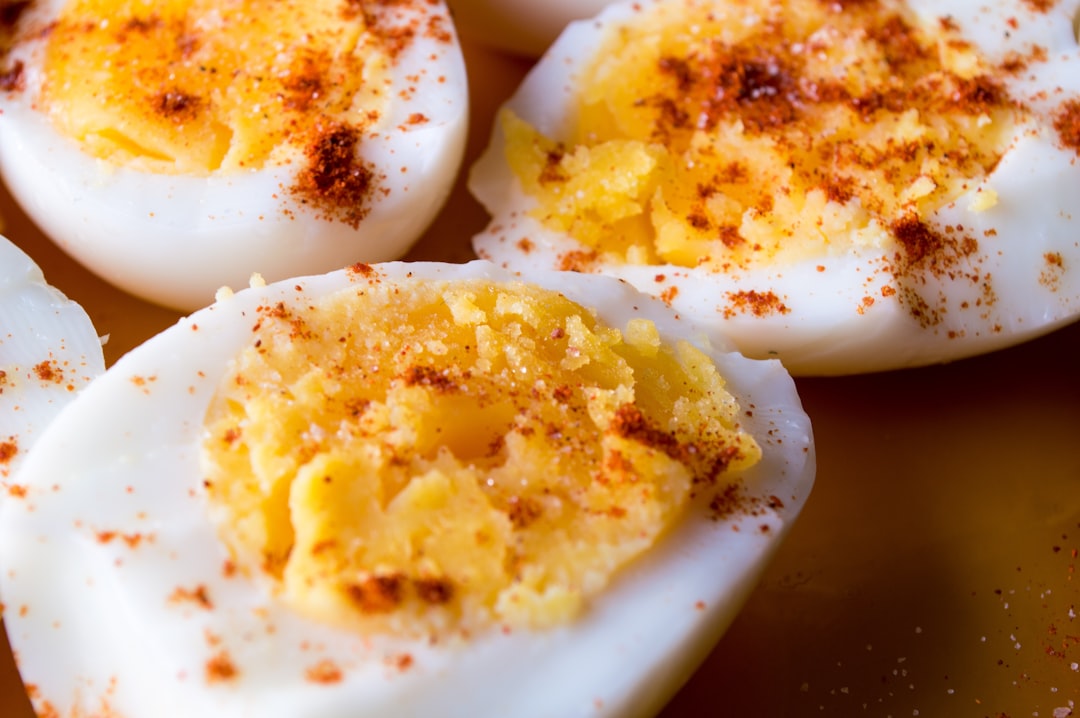
A properly hard boiled egg, when sliced, shows a completely opaque, pale yellow yolk with no translucent or gel-like center. But you don't have to crack it to check. Set the egg on a flat surface and spin it. A hard boiled egg spins smoothly and quickly because everything inside is solid. A raw egg wobbles because the liquid shifts around inside. This short YouTube video demonstrates the spin test clearly in under a minute.
Peeling Technique
After the ice bath, tap the wide end of the egg firmly on a hard surface, then roll it gently under your palm to crack the shell all over. Peel under a thin stream of running cold water. The water helps the membrane slip off cleanly and carries away small shell fragments.
Altitude Adjustments
Above 3,500 ft (1,067 m): add 2 extra minutes to either method. Above 7,000 ft: add 3 to 4 extra minutes, and keep the lid on during the off-heat resting phase to retain as much heat as possible.
Pro Tips for Perfect Hard Boiled Eggs Every Time
Even with the right timing, a few extra techniques separate good hard boiled eggs from great ones.
Add baking soda to the water. Dropping 1 teaspoon of baking soda into the boiling water raises the water's pH, which in turn speeds up the pH change in the egg white. This makes even very fresh eggs easier to peel, because it loosens the bond between the white and the shell membrane. Butter Be Ready recommends this trick specifically for situations where you can't wait for eggs to age in the fridge.
Don't overcrowd the pot. Eggs that are packed in too tightly knock against each other as the water boils, causing hairline cracks. Those cracks let water seep into the egg and create a rubbery, uneven white. RecipeTinEats suggests using a pot large enough that eggs sit in a single layer with a little breathing room.
Match pot size to egg quantity. When you lower eggs into boiling water, the temperature drops. A pot that's correctly sized brings the water back to a simmer within 60 to 90 seconds. A pot that's too small struggles to recover, which throws off your timing.
Use a pin on the wide end. Pricking a tiny hole in the wide end of the egg before boiling releases the air pocket sitting just under the shell. This reduces the pressure that causes cracking during cooking, a trick used in professional kitchens for decades.
Don't skip the ice bath. The grey-green ring around an overcooked yolk isn't harmful, but it is a sign that something went wrong. It forms when iron in the yolk reacts with hydrogen sulfide from the white, a reaction that kicks in when the egg cooks too long or cools too slowly. An immediate ice bath stops cooking within seconds and prevents the reaction from completing.
Know your storage limits. Hard boiled eggs in their shells last up to one week in the refrigerator. Peeled hard boiled eggs should go into an airtight container or a bowl of cold water (changed daily) and are best eaten within 5 days. Our guides on how long eggs are good in the refrigerator and egg shelf life have the full breakdown. One thing to avoid: don't freeze whole or peeled hard boiled eggs. The whites turn rubbery and watery when thawed. Hard boiled yolks, however, can be frozen successfully for up to 3 months.
Plan what to do with them. Once you've nailed the technique, hard boiled eggs are endlessly versatile. Our devilled egg guide is a great next step if you want a crowd-pleasing recipe that shows off a perfectly cooked yolk. You might also want to explore how to do a poached egg in the microwave as another quick egg-cooking method for weekday mornings.
Hard Boiled Eggs FAQ
How long do you boil eggs for hard boiled eggs?
Boil eggs for 12 minutes in already-boiling water for a fully hard boiled egg with a firm, completely set yolk. If starting from cold water, bring to a boil, then let eggs sit covered off the heat for 14 minutes. Always follow with a 5 to 10 minute ice bath. These times are based on large eggs at sea level; both RecipeTinEats and Butter Be Ready confirm this as the reliable benchmark.
What is the difference between the cold-start and boiling-water-start method?
The boiling-water-start method gives more precise timing control and is preferred by professional chefs. Eggs go into already-boiling water and cook for exactly 12 minutes. The cold-water-start method places eggs in cold water, brings everything to a boil together, then uses residual heat off the stove for 14 minutes. Cold-start is more forgiving for beginners and reduces shell cracking because the eggs warm up gradually.
Why are my hard boiled eggs hard to peel?
Very fresh eggs are difficult to peel because the albumen has a low pH and bonds tightly to the inner shell membrane. Use eggs that have been in your refrigerator for 7 to 10 days, or add 1 teaspoon of baking soda to the boiling water to raise the pH and loosen that bond. An ice bath immediately after cooking also helps the egg contract slightly away from the shell.
How can I tell if a hard boiled egg is fully cooked without cracking it?
Place the egg on a flat surface and spin it. A hard boiled egg spins smoothly and rapidly because its contents are solid. A raw or undercooked egg wobbles and slows quickly because the liquid interior shifts. You can also hold the egg up to a bright light. A fully hard boiled egg appears uniformly opaque with no visible shadow of a runny yolk.
How long do hard boiled eggs last in the refrigerator?
Hard boiled eggs kept in their shell last up to 7 days in the refrigerator. Peeled hard boiled eggs should be stored in an airtight container or submerged in cold water (refreshed daily) and eaten within 5 days. Never leave hard boiled eggs at room temperature for more than 2 hours.
Does altitude affect how long it takes to hard boil an egg?
Yes. At altitudes above 3,500 feet (1,067 m), water boils at temperatures below 212°F (100°C), which slows cooking. Add 1 to 2 extra minutes at 3,500 to 6,000 ft, and 3 to 4 extra minutes above 7,000 ft. Keeping a lid on the pot during the off-heat resting phase also helps retain heat at high altitude.
Can you hard boil eggs in an Instant Pot?
Yes. The popular 5-5-5 Instant Pot method (5 minutes on high pressure, 5 minutes natural pressure release, then 5 minutes in an ice bath) consistently produces easy-to-peel hard boiled eggs. This method works especially well with very fresh eggs that would be difficult to peel using the stovetop method. Read our full Instant Pot hard boiled eggs guide for detailed instructions.
Why is there a grey ring around my hard boiled egg yolk?
The grey-green ring around the yolk forms when iron in the yolk reacts with hydrogen sulfide released from the egg white during overcooking or slow cooling. It's completely safe to eat, but it signals the egg cooked too long or wasn't transferred to an ice bath quickly enough. Stick to 12 to 14 minutes of total cooking time and use an immediate ice bath to prevent it every time.